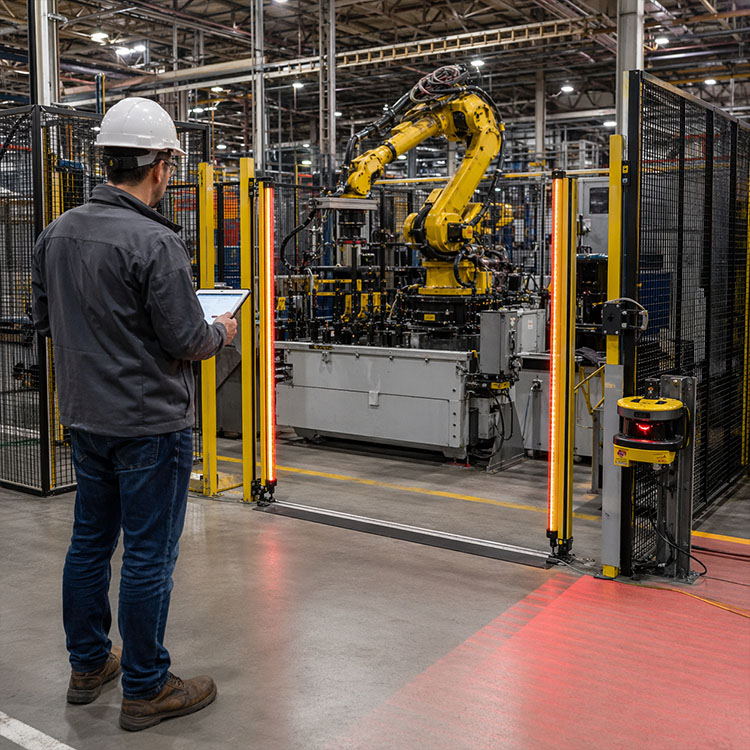
Vous avez besoin d'une barrière immatérielle de sécurité adaptée à votre machine ?
Indiquez-nous votre type de machine et vos exigences en matière de protection. Notre équipe d'ingénieurs vous aidera à sélectionner une barrière immatérielle de sécurité, un capteur ou un lidar de sécurité adapté à votre projet.
Obtenir de l'aide pour :
Projets de barrières immatérielles de sécurité standard et sur mesure
Besoins en matière d'OEM, d'intégration, de distribution et de mise à niveau de l'usine
Sélection des produits en fonction de la configuration de la machine, de la plage de détection, du rendement et de l'environnement
Le vilain secret du gardiennage de cellules par des robots
La plupart des discussions sur la protection des cellules robotisées commencent au mauvais endroit.
Ils commencent par le matériel.
Je pense que c'est à l'envers. Une barrière immatérielle, un scanner de sécurité ou un dispositif hybride de protection des machines n'est que la partie visible d'une décision qui aurait dû commencer par les trajectoires de mouvement, les performances d'arrêt, les abus prévisibles, les tâches de maintenance, l'emplacement de la réinitialisation et la question de savoir si la cellule crée un espace mort où une personne peut disparaître de la vue du système de contrôle. Selon l'OSHA, de nombreux accidents de robots se produisent lors de travaux non routiniers tels que la programmation, la maintenance, les tests, la configuration ou le réglage, ce qui correspond exactement au moment où les dessins de vente bien ordonnés ne correspondent plus au comportement de l'atelier.
Cela devrait mettre les acheteurs mal à l'aise.
Bon.
En effet, la sécurité des cellules robotisées ne consiste pas à acheter le capteur le plus perfectionné. Il s'agit de contrôler l'accès aux mouvements dangereux sans obliger les opérateurs, les techniciens et les superviseurs de production à trouver des solutions de contournement le vendredi après-midi.
Si vous comparez encore une barrière immatérielle à un scanner de sécurité comme s'il s'agissait d'un simple concours de fiches techniques, vous ne faites pas de la protection de machines pour des cellules robotisées. Vous faites du shopping.
Et le shopping n'est pas une question de sécurité.
Table des matières
Les barrières immatérielles : Rapides, familiers et souvent trop fiables
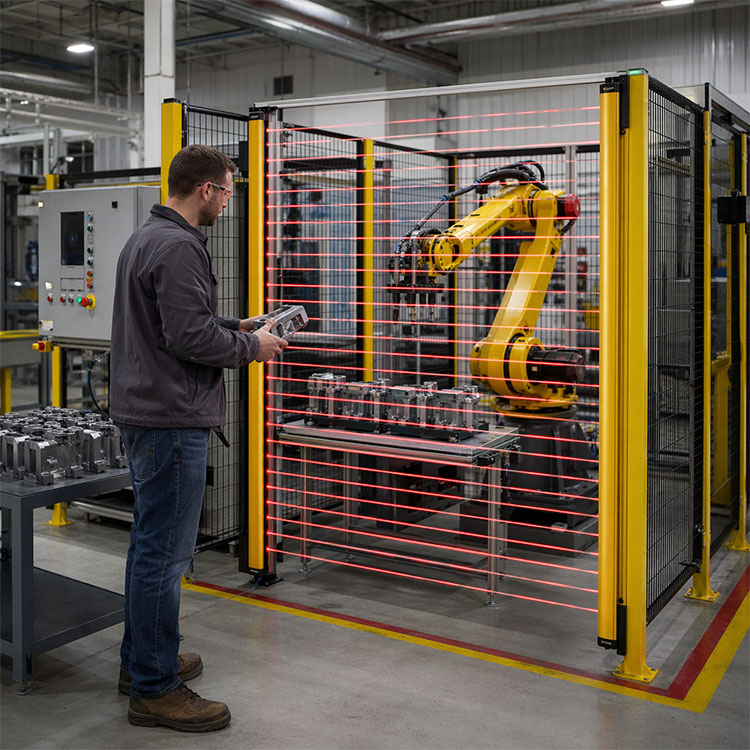
Une barrière immatérielle de sécurité est utile lorsque le danger est prévisible, que le point d'accès est défini et que la machine peut s'arrêter avant qu'une personne n'atteigne la zone dangereuse.
Cette dernière partie est importante.
J'ai vu trop d'agencements de cellules robotisées où le rideau de lumière est traité comme une porte magique. Il suffit de briser les faisceaux, d'arrêter le robot et le tour est joué. Mais la documentation de l'OSHA sur la protection des machines indique que la distance de sécurité minimale dépend de la capacité d'arrêt de la machine, de la vitesse des mains, du temps de réponse du système, du temps de réponse du dispositif de détection, du temps de réponse de l'interface et d'autres facteurs, et pas seulement de l'existence de faisceaux infrarouges.
Une barrière immatérielle est plus efficace lorsque l'ouverture est étroite, que la direction d'approche est contrôlée et que la hauteur protégée correspond au risque réel d'accès pour le corps humain. Pour de nombreuses cellules robotisées de chargement final, stations de pressage, points d'accès à la palettisation et fenêtres de chargement de machines, une barrière immatérielle correctement appliquée peut s'avérer très utile. rideau lumineux de sécurité reste l'une des options les plus propres.
Mais il faut se rendre à l'évidence : les rideaux de lumière ne permettent pas de se souvenir des gens.
Ils détectent l'entrée par le faisceau. Ils ne savent pas automatiquement si quelqu'un est resté à l'intérieur d'une grande cellule robotisée après la réinitialisation du faisceau, à moins que l'architecture de sécurité au sens large ne prenne en compte ce risque au moyen de la détection de présence, de la prévention des personnes piégées, de contrôles de redémarrage, de vérifications visuelles, de verrouillages, de zonages ou d'autres mesures.
Ce n'est pas une théorie. Dans un rapport d'accident de l'OSHA datant de 2020, des travailleurs ont pénétré dans une cellule robotisée à travers des rideaux lumineux pendant la maintenance. Un autre travailleur a réinitialisé les rideaux lumineux du périmètre et a lancé un cycle de test pendant que les travailleurs restaient à l'intérieur ; un employé a subi de graves blessures au pied après l'activation d'une table de poussée du robot.
Lisez encore une fois.
Le rideau de lumière a fonctionné comme une porte. Le système de sécurité a échoué comme un souvenir.
Là où les rideaux légers l'emportent le plus souvent
Les rideaux de lumière l'emportent généralement lorsque la cellule du robot a.. :
Un point d'entrée fixe
Temps d'arrêt court et mesurable
Accès fréquent à l'opérateur
Tolérance limitée en matière d'espace au sol pour les portails battants
Faible risque que quelqu'un se tienne caché à l'intérieur de la zone protégée
Nécessité d'un chargement ou d'un déchargement en douceur des pièces
Un système de contrôle de sécurité qui empêche le redémarrage lorsque le faisceau est interrompu.
Ils sont particulièrement utiles pour les zones de chargement compactes, les stations de maintenance des machines, les petites cellules d'automatisation et les points d'accès surveillés où les opérateurs ont besoin d'une interaction rapide et reproductible sans avoir à ouvrir physiquement un portail à chaque cycle.
Pour des besoins de détection plus étroits (accès au doigt, à la main ou à de petites pièces), les ingénieurs se tournent souvent vers un système de contrôle de la qualité. rideau lumineux de haute précision plutôt qu'un modèle polyvalent. Ce choix doit résulter de l'évaluation des risques, et non de la préférence de l'acheteur pour “plus de poutres”.”
L'augmentation du nombre de poutres n'est pas la solution à une mauvaise architecture.
Scanners de sécurité : Des zones plus intelligentes, plus de possibilités de se tromper
Les scanners de sécurité, souvent appelés scanners laser de sécurité ou lidar de sécurité dans un langage d'achat plus large, résolvent un problème différent.
Ils surveillent une zone.
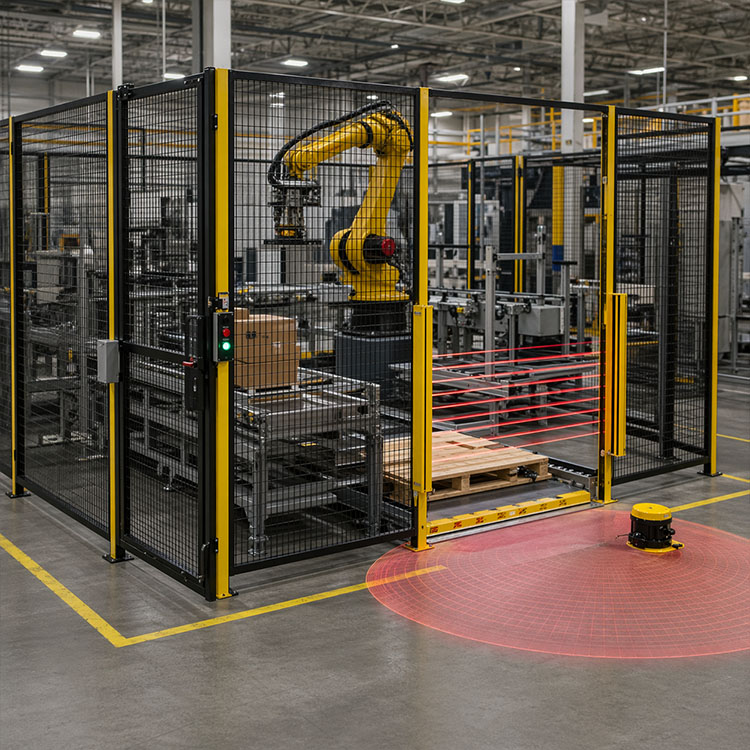
Cela semble simple, mais cela change la conversation sur le gardiennage des cellules robotisées. Au lieu de surveiller un seul plan d'entrée, un scanner peut surveiller des zones de sol, des zones d'avertissement, des zones de protection et parfois des zones différentes en fonction de l'état de la machine. Pour les cellules robotisées avec des côtés ouverts, l'accès aux chariots, l'interaction AGV/AMR, le flux de palettes ou les changements de trajectoires d'approche, lidars de sécurité peut s'avérer bien plus judicieux qu'un rideau lumineux vertical.
Mais les scanners ne sont pas non plus magiques.
La poussière, la réflectivité, la hauteur de montage, la configuration du champ, les déclenchements intempestifs, la pression de contournement, les angles morts, la logique de redémarrage et la résolution de l'objet sont autant d'éléments importants. Un scanner installé trop bas, trop haut, trop près ou avec une conception de zone paresseuse peut donner à la direction une impression de chaleur tout en laissant les risques réels intacts.
Et oui, les gens contourneront les zones si la cellule les punit pour avoir fait leur travail.
Ne le feriez-vous pas ?
Les meilleures applications de scanners ont généralement une raison d'être pour les champs flexibles : circulation de robots mobiles, transfert de palettes, grandes ouvertures au sol, zones de collaboration à vitesse lente, ou automatisation multi-états où le système a besoin d'un comportement de protection différent pendant l'apprentissage, la configuration, le fonctionnement automatique et l'échange de matériel.
Si la cellule n'a qu'une seule fenêtre d'accès propre, un scanner peut s'avérer excessif. Si la cellule a plusieurs voies d'accès ambiguës, un scanner peut être la première réponse honnête.
Là où les scanners de sécurité gagnent généralement
Les scanners de sécurité l'emportent généralement lorsque la cellule robotisée a.. :
Zones d'accès larges ou ouvertes
Risque d'approche au niveau du sol
Mouvement AGV, AMR, de chariots ou de palettes
Besoins en matière de surveillance dynamique des zones
Plusieurs états de la machine nécessitant des zones différentes
Nécessité de zones d'avertissement avant les zones d'arrêt complet
Cellules de grande taille pour lesquelles la détection d'entrée ne suffit pas
C'est pourquoi la sécurité des cellules robotisées par scanner est courante dans l'automatisation des entrepôts, la palettisation, l'intralogistique et la manutention robotisée. La cellule n'est pas une simple boîte clôturée. Elle fait partie d'un système en mouvement.
Protection hybride : L'option que les intégrateurs sérieux préfèrent discrètement
La garde hybride n'est pas un compromis. S'il est bien fait, c'est la solution pour les adultes.
Un dispositif hybride de protection des cellules robotisées peut combiner des clôtures fixes, des barrières verrouillées, des barrières immatérielles, des scanners de sécurité, des arrêts surveillés de sécurité, des dispositifs d'habilitation, des stations de réinitialisation, des dispositifs de prévention des personnes piégées, des panneaux de signalisation et des procédures de verrouillage basées sur les tâches à accomplir. Il ne s'agit pas de “plus de matériel”. Il s'agit d'un contrôle par couches.
L'interprétation de l'OSHA de 2005 sur les navettes de blanchisserie robotisées est sans détour : les voyants d'avertissement, les alarmes, les panneaux, la formation et les arrêts d'urgence ne fournissent normalement pas à eux seuls une protection adéquate lorsque les employés peuvent être exposés aux dangers de la machine. L'OSHA préconise plutôt des barrières fixes qui ne sont pas faciles à franchir, des barrières de protection à verrouillage qui arrêtent le mouvement ou des dispositifs de détection de présence qui arrêtent le mouvement. L'OSHA a également souligné que le système choisi doit réellement protéger les travailleurs contre le risque spécifique au robot.
C'est la phrase que les acheteurs devraient imprimer et coller au mur de la salle de conférence.
Le gardiennage hybride est le plus efficace lorsque la cellule robotisée dispose de plusieurs modes d'accès. L'accès à la production n'est pas un accès à la maintenance. L'échange de palettes n'est pas un mode d'apprentissage. L'élimination des bourrages n'est pas une opération normale. Le nettoyage n'est pas un cycle automatique.
Des tâches différentes méritent des couches de protection différentes.
A barrière immatérielle de protection d'accès multilatérale peuvent protéger plusieurs ouvertures définies, tandis que des scanners surveillent les entrées au niveau du sol ou les zones de palettes. Les clôtures fixes empêchent le trafic occasionnel d'entrer. Des barrières verrouillées gèrent l'accès de la maintenance. Une station de réinitialisation correctement placée force la visibilité avant le redémarrage. La logique relie le tout.
Peu glamour. Efficace.
Tableau de comparaison : Barrière immatérielle vs Scanner de sécurité vs Protection hybride
Méthode de gardiennage
Meilleure adaptation
Principaux points forts
Principale faiblesse
Observer de près
Mon avis
Rideau lumineux
Points d'accès définis, fenêtres de chargement, cellules robotisées compactes
Rapide, familier, peu d'obstacles physiques
Faible capacité à détecter une personne qui reste à l'intérieur d'une cellule plus grande après une réinitialisation
Temps d'arrêt, distance de sécurité, logique de redémarrage, zones aveugles
Meilleur pour les ouvertures contrôlées, pas pour la sensibilisation à l'ensemble de la cellule.
Scanner de sécurité / Scanner laser de sécurité
Zones de plancher ouvertes, chemins AGV/AMR, mouvements de palettes, grandes zones d'approche
Champs de protection et d'alerte configurables
Il est facile d'en faire une mauvaise utilisation si la conception de la zone est faible ou si le montage est médiocre.
Disposition des champs, résolution, interférences environnementales, déplacements gênants
Efficace lorsque la géométrie de la cellule est désordonnée
Protection hybride
Cellules robotisées complexes avec production, maintenance, flux de palettes et modes d'accès multiples
Protection multicouche adaptée aux tâches réelles
Effort de conception plus important et travail de validation plus important
Logique du PLC de sécurité, emplacement de réinitialisation, risque de personne piégée, enregistrements de validation
C'est généralement la réponse la plus sûre pour une automatisation sérieuse.
Protections fixes + barrières verrouillées
Cellules nécessitant beaucoup d'entretien, risques de gravité élevée, accès à faible fréquence
Contrôle d'accès physique
Interaction plus lente avec l'opérateur
Risque de défaite, placement de la porte, interface de verrouillage
Sous-estimé parce qu'il n'est pas à la mode
Barrière immatérielle + scanner
Point de chargement défini et surveillance du plancher ouvert
Combine le contrôle de l'entrée et la connaissance de la zone
Une mise en service plus complexe
Inhibition, suppression, redémarrage, commutation de zone
Idéal lorsque les opérateurs et les matériaux partagent un espace peu pratique
Le risque dont les acheteurs de données préfèrent ne pas parler
Les accidents de robots ne sont pas énormes en nombre brut par rapport aux accidents de transport ou aux chutes, mais ce n'est pas la bonne mesure de confort. Le profil de gravité est affreux.
Le NIOSH a examiné les données du Bureau of Labor Statistics pour la période 1992-2017 et a identifié 41 décès liés à des robots sur le lieu de travail. Dans cette étude, 85% des victimes étaient des hommes, 83% impliquaient des robots stationnaires, et plus des trois quarts se sont produits alors que le robot était alimenté en énergie pour fonctionner seul, souvent pendant la maintenance.
Petits nombres. Résultats graves.
Le contexte plus large des accidents du travail mortels n'est pas rassurant non plus. Le BLS fait état de 5 070 accidents du travail mortels aux États-Unis en 2024, soit une baisse de 4,0% par rapport aux 5 283 de 2023, avec un taux d'accidents du travail mortels de 3,3 pour 100 000 travailleurs équivalents temps plein.
Ainsi, lorsque quelqu'un dit “Nous n'avons jamais eu d'accident ici”, j'entends un argument peu convaincant.
Une cellule robotisée peut fonctionner silencieusement pendant 500 000 cycles, mais il suffit d'une mauvaise réinitialisation pour qu'elle se blesse. Le risque ne se préoccupe pas de la durée d'utilisation.
Comment je choisirais un robot de protection cellulaire
Commencez par la carte des tâches.
Pas le catalogue. Pas le capteur le moins cher. Pas la marque préférée de l'intégrateur.
Dressez la liste de toutes les interactions humaines avec la cellule robotisée : chargement normal, déchargement, inspection, élimination des bourrages, changement d'outil, mode d'apprentissage, nettoyage, maintenance préventive, dépannage, contrôles de qualité, échange de palettes, élimination des déchets et redémarrage après une défaillance. Demandez ensuite qui entre, où il se trouve, ce qui a encore de l'énergie et ce que le robot peut faire de manière inattendue.
C'est là que la réponse commence.
Choisissez une barrière immatérielle lorsque l'accès est étroit et prévisible
Utilisez une cellule robotisée à rideau lumineux lorsque l'ouverture protégée est bien définie et que la personne ne peut pas atteindre le danger avant que le mouvement ne s'arrête. Le choix dépend du temps d'arrêt mesuré, de la hauteur de protection, de la résolution et de la distance de sécurité.
Si la cellule dispose d'une fenêtre de chargement pour l'opérateur et que le robot s'arrête suffisamment vite, une barrière immatérielle est suffisante. Si le travailleur peut pénétrer complètement à l'intérieur et se cacher derrière un luminaire, il faut plus qu'une détection d'entrée.
Choisir un scanner de sécurité lorsque le sol est un problème
Utilisez un scanner laser de sécurité pour les cellules robotisées lorsque le risque est de pénétrer dans une zone, et pas seulement de franchir une ligne. Cette situation est fréquente à proximité des convoyeurs de palettes, des itinéraires AMR, des tables tournantes, des dispositifs de soudage et des grandes enveloppes robotisées où la position au sol est importante.
Mais il ne faut pas que le scanner devienne un substitut paresseux à la protection. Si le danger projette des étincelles, éjecte des pièces, crée un éclair de soudure ou expose les personnes à des débris volants, la détection électronique de la présence peut ne pas suffire à traiter le danger secondaire.
Choisissez le gardiennage hybride lorsque le travail réel est désordonné
Le gardiennage hybride est préférable lorsque la production et la maintenance utilisent différemment la même cellule. C'est également la meilleure solution lorsque la cellule comporte plusieurs points d'accès, des mouvements mixtes de personnes et de matériel, des espaces cachés ou des mouvements de haute gravité.
Pour les acheteurs qui comparent les protections de machines pour les cellules robotisées, c'est là que les preuves internes sont utiles. Examen études de cas sur la sécurité des cellules robotisées et les notes d'application avant de verrouiller la liste des dispositifs, car une cellule de palettisation, un robot de pressage, une cellule de soudage et une cellule d'automatisation d'entrepôt ne méritent pas le même ensemble de protections.
La bonne question n'est pas “Quel est le meilleur dispositif de sécurité pour les cellules robotisées ?”.”
La bonne question est la suivante : “Quelle combinaison de mesures de protection permet de contrôler chaque tâche sans encourager le contournement ?”.”
La conversation sur les normes : Arrêtez de prétendre qu'une seule règle résout tout
Aux États-Unis, l'OSHA indique qu'il n'existe actuellement aucune norme OSHA spécifique pour l'industrie de la robotique, tout en orientant les employeurs vers des normes connexes et des exigences en matière de protection des machines.
Cela ne signifie pas que les cellules robotisées ne sont pas réglementées.
Cela signifie que vous ne pouvez pas vous cacher derrière une seule règle de robotique.
Les références pertinentes peuvent inclure OSHA 29 CFR §1910.212 pour la protection des machines, OSHA 29 CFR §1910.147 pour la déconnexion pendant l'entretien, ANSI/A3 R15.06-2025 pour la sécurité des robots industriels, ISO 10218-1:2025 pour les robots industriels, ISO 10218-2:2025 pour les applications et cellules robotisées industrielles, ISO 13849-1 pour les systèmes de commande relatifs à la sécurité, IEC 61496 pour les équipements de protection électrosensibles, et ISO 13855 pour les protections de positionnement relatives aux vitesses d'approche.
Cela semble technique parce que c'est technique.
Et si un fournisseur ne peut pas parler de temps d'arrêt, de distance de sécurité, de sorties OSSD, d'architecture PL d / catégorie 3, de logique de réinitialisation, de muting, de blanking, de commutation de champ et d'accès à la maintenance sans dériver vers des slogans, je ne le laisserais pas définir la stratégie de sécurité de ma cellule robotisée.
Utiliser un système structuré sélection des dispositifs de sécurité processus. Demandez ensuite les plans, la logique de câblage, les spécifications du modèle, les hypothèses de validation et les contraintes d'installation avant que le bon de commande ne soit émis.
Drapeaux rouges en matière de marchés publics que je n'ignorerais pas
Certaines erreurs apparaissent avant qu'un seul capteur ne soit expédié.
Un fournisseur propose un rideau de lumière sans poser de question sur le temps d'arrêt.
Mauvais signe.
Un intégrateur recommande un scanner sans se préoccuper de la hauteur des palettes, des reflets du sol, de la contamination ou de la commutation des zones.
Également mauvais.
Une usine veut un gardiennage hybride mais refuse de décider qui est autorisé à réinitialiser la cellule et d'où.
Très mauvais.
Voici ma liste de contrôle pour l'acheteur :
Drapeau rouge
Pourquoi c'est important
Ce qu'il faut demander à la place
“Il suffit d'installer un rideau de lumière à l'ouverture.”
La détection d'entrée peut ne pas détecter une personne restée à l'intérieur
Qu'est-ce qui empêche le redémarrage si une personne est encore dans la cellule ?
Pas de données sur les temps d'arrêt
La distance de sécurité devient une approximation
Quel est le temps d'arrêt le plus défavorable mesuré sous charge ?
Pas de répartition des tâches
Le risque de maintenance est ignoré
Quelles sont les tâches qui nécessitent un accès, et dans quel état énergétique ?
Station de réinitialisation cachée de la cellule
L'opérateur peut redémarrer sans visibilité totale
L'opérateur de réinitialisation peut-il voir l'ensemble de la zone protégée ?
Zones de numérisation copiées à partir d'un autre projet
La géométrie des cellules et le flux de trafic diffèrent
Où sont validés les champs d'alerte et de protection ?
Pas de discussion sur la déconnexion
Le risque de service est traité comme le risque de production
Quelles sont les tâches qui relèvent de la norme 29 CFR §1910.147 ?
Un fournisseur sérieux devrait répondre favorablement à ces questions. En cas de géométrie inhabituelle des cellules, de montage personnalisé, d'accès multilatéral, d'environnements humides ou de contraintes liées à la plate-forme OEM, il convient de se demander si support de rideau lumineux de sécurité pour machine sur mesure est plus réaliste que d'imposer un produit standard à un risque non standard.
Mon avis sur le gardiennage robotisé des cellules
Les barrières immatérielles ne sont pas obsolètes.
Les scanners de sécurité ne sont pas automatiquement plus intelligents.
Le gardiennage hybride n'est pas automatiquement une suringénierie coûteuse.
Le meilleur dispositif est celui qui correspond au danger, à la tâche, à la performance d'arrêt et au comportement réel des personnes qui travailleront autour de la cellule à 2 heures du matin, lorsque la production est en retard et que la maintenance est fatiguée.
C'est la partie que les brochures omettent de mentionner.
Pour un contrôle d'accès simple, choisissez la bonne barrière immatérielle et calculez la distance de sécurité. Pour la détection de zones ouvertes, utilisez un scanner de sécurité avec des zones validées. Pour les cellules robotisées complexes, cessez de prétendre qu'un seul dispositif peut supporter l'ensemble des risques. Construisez une protection hybride en fonction du travail réellement effectué.
FAQ
Qu'est-ce que le gardiennage de cellules robotisées ?
La protection des cellules robotisées est l'utilisation technique de barrières, d'interverrouillages, de dispositifs de détection de présence, de scanners de sécurité, de barrières immatérielles, de logiques de contrôle, de contrôles de réinitialisation et de procédures pour empêcher les personnes d'être exposées aux mouvements dangereux des robots pendant les tâches de production, d'installation, de maintenance, d'essai et de récupération à l'intérieur ou à proximité d'une cellule automatisée.
L'expression est importante car une cellule robotisée ne se limite pas au bras du robot. Elle comprend l'effecteur, le dispositif de fixation, le convoyeur, la table tournante, l'outillage, les dispositifs pneumatiques, les pinces hydrauliques, les commandes électriques, les points d'accès et les flux de travail humains autour de l'automatisation.
Un rideau lumineux est-il préférable à un scanner de sécurité pour la sécurité des cellules robotisées ?
Une barrière immatérielle est préférable lorsque l'accès se fait par une ouverture définie et que le robot peut s'arrêter avant qu'une personne n'atteigne le danger, tandis qu'un scanner de sécurité est préférable lorsque la surveillance de la surface au sol, les zones flexibles, les mouvements de palettes ou le trafic d'automatisation mobile créent des risques d'approche plus importants.
En termes clairs, les barrières immatérielles protègent mieux les portes que les sols ouverts. Les scanners de sécurité protègent mieux les étages ouverts que les portes étroites. Le gardiennage hybride utilise souvent les deux, car les cellules robotisées réelles se comportent rarement comme des modèles CAO propres.
Quand dois-je utiliser une protection hybride pour les cellules robotisées ?
La sécurisation hybride des machines doit être utilisée lorsqu'une cellule robotisée comporte plusieurs points d'accès, différentes tâches de production et de maintenance, de grands espaces internes, des zones cachées, des mouvements de palettes ou de chariots, une interaction AGV/AMR ou des risques de gravité élevée qui ne peuvent pas être contrôlés par un seul dispositif de détection de présence.
C'est la configuration à laquelle je fais le plus confiance pour une automatisation sérieuse. Des protections fixes contrôlent le périmètre, des barrières verrouillées gèrent l'accès pour la maintenance, des barrières immatérielles protègent les points de chargement fréquents, des scanners surveillent les zones au sol et une logique de sécurité empêche les redémarrages dangereux.
Une barrière immatérielle de sécurité peut-elle empêcher une personne d'être piégée à l'intérieur d'une cellule robotisée ?
Une barrière immatérielle de sécurité ne peut généralement pas garantir à elle seule la prévention des personnes piégées, car elle détecte l'interruption de son champ de détection, et non une présence humaine continue partout à l'intérieur d'une grande cellule robotisée après que le champ a été dégagé et réinitialisé.
C'est pourquoi la logique de redémarrage, l'emplacement de la réinitialisation, la visibilité de la cellule entière, la détection de présence secondaire, les systèmes de clés piégées, les portes verrouillées, les scanners ou les procédures de verrouillage administratif peuvent s'avérer nécessaires. Le cas de blessure par cellule robotisée de l'OSHA impliquant des rideaux lumineux à réarmement pendant la maintenance est un rappel douloureux de cette lacune.
Comment choisir le meilleur dispositif de sécurité pour les cellules robotisées ?
Le meilleur dispositif de sécurité pour les cellules robotisées est choisi en cartographiant chaque tâche humaine, en mesurant les performances d'arrêt, en identifiant les voies d'accès, en évaluant les risques liés aux espaces cachés, en vérifiant les conditions environnementales et en sélectionnant les mesures de protection qui contrôlent chaque exposition dangereuse sans encourager les contournements ou les redémarrages dangereux.
Commencez par l'évaluation des risques. Sélectionnez ensuite le matériel. Si le fournisseur commence par les numéros de pièces avant de poser des questions sur le temps d'arrêt, le comportement d'accès, les tâches de maintenance et la logique de réinitialisation, il faut ralentir le processus d'achat.
Dernières réflexions : N'achetez pas un capteur avant d'avoir défini le danger
Si vous prévoyez d'installer une nouvelle cellule robotisée, de moderniser une ancienne cellule ou de comparer une barrière immatérielle à un scanner de sécurité ou à un système de protection hybride, n'envoyez pas un vague appel d'offres indiquant que vous avez besoin d'un capteur de sécurité pour robot.“
Envoyez la configuration de la machine, les points d'accès, la hauteur de protection, la portée de détection, les données relatives au temps d'arrêt si elles sont disponibles, la description de la tâche du robot, l'emplacement de réinitialisation, l'environnement, les sorties requises et le marché cible. Demandez ensuite une recommandation de protection qui explique pourquoi le dispositif choisi est adapté au risque.